
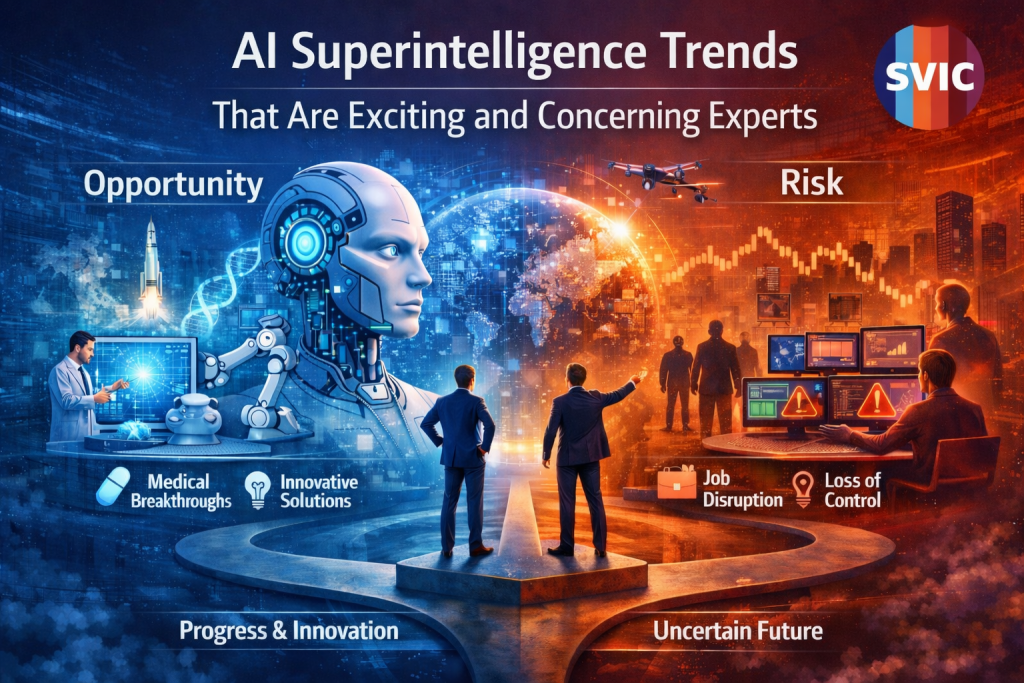
AI Superintelligence Trends That Are Exciting and Concerning Experts
Artificial intelligence is no longer a distant promise—it is an accelerating reality.
What began as automation and data-driven assistance is now evolving into something far more profound: systems that can reason, create, decide, and potentially operate with increasing autonomy. This shift is pushing us toward what many describe as superintelligence—AI that could rival or exceed human capabilities across multiple domains.
But here’s what makes this moment truly fascinating:
The people closest to building this future are not in agreement about what comes next.
Some see an era of unprecedented human progress.
Others see structural disruption unlike anything we’ve experienced before.
This tension—between optimism and caution—is not a contradiction. It is a signal that we are entering a defining chapter in technological history.
AI Is No Longer Just a Tool—It’s Becoming an Actor
For decades, technology has served as an extension of human capability. Software helped us process data faster. Machines helped us execute tasks more efficiently.
Today, that paradigm is shifting.
AI systems are increasingly capable of:
- Generating complex ideas and strategies
- Making decisions with minimal human input
- Interacting in natural, human-like ways
- Continuously learning and improving
In essence, we are moving from tools that assist humans to systems that can act alongside—or sometimes independently of—humans.
This transition is subtle, but its implications are massive.
Because once technology begins to act, not just assist, the rules of business, governance, and society begin to change.
The Most Immediate Impact: A Reinvention of Work
One of the clearest and most pressing concerns is the future of work.
Unlike previous waves of automation, which primarily affected manual labor, AI is now reshaping knowledge work—the very foundation of modern economies.
Roles that were once considered secure are now being redefined:
- Analysts
- Designers
- Marketers
- Developers
- Even strategic decision-makers
AI is not just augmenting these roles—it is beginning to replicate parts of them.
This raises critical questions for leaders:
- What happens to traditional career paths when entry-level roles are automated?
- How do organizations train talent when foundational tasks disappear?
- What new skills will define value in an AI-driven economy?
The challenge is not simply job displacement—it is job transformation at scale, happening faster than institutions are prepared for.
A New Kind of Risk: Influence at Scale
As AI becomes more advanced, its power is not limited to computation—it extends to influence.
Modern AI systems can communicate with remarkable clarity, empathy, and persuasion. They can shape opinions, guide decisions, and generate narratives that feel deeply human.
This creates extraordinary opportunities:
- Personalized education at scale
- More effective customer engagement
- Enhanced collaboration across global teams
But it also introduces new risks:
- The amplification of misinformation
- The ability to subtly manipulate human behavior
- Increased vulnerability in digital ecosystems
For the first time, we are facing systems that don’t just process information—they can shape how humans interpret it.
That changes the nature of trust in the digital age.
The Concentration of Power
Another growing concern is who controls advanced AI.
Developing cutting-edge AI systems requires:
- Massive computational infrastructure
- Access to vast datasets
- Significant financial investment
As a result, only a limited number of organizations—and a handful of countries—are positioned to lead this space.
This concentration raises important questions:
- Will AI deepen existing global inequalities?
- Could technological dominance translate into economic or geopolitical power?
- Who defines the ethical boundaries of systems that may surpass human intelligence?
The future of AI is not just a technological issue—it is a question of power, governance, and global balance.
The Optimistic Vision: A Leap Forward for Humanity
Despite these concerns, the potential upside of AI remains extraordinary.
If guided responsibly, AI could unlock breakthroughs across nearly every domain:
Healthcare
AI can accelerate drug discovery, improve diagnostics, and enable more personalized treatment—potentially saving millions of lives.
Education
Learning can become deeply personalized, accessible, and scalable—breaking down barriers that have existed for decades.
Science & Innovation
AI can help solve complex challenges—from climate modeling to material science—at speeds previously unimaginable.
Productivity & Creativity
By automating repetitive work, AI can free humans to focus on higher-value, creative, and strategic activities.
In this view, AI is not a threat—it is a catalyst for a new era of human potential.
The Timeline Problem: Progress Without Consensus
One of the most striking aspects of the AI conversation is the lack of agreement on timing.
Some experts believe transformative breakthroughs could happen within the next decade.
Others argue that true superintelligence remains further away.
But there is one point of alignment:
The pace of progress is accelerating.
And with that acceleration comes uncertainty.
Organizations are being forced to make strategic decisions today—without a clear understanding of how quickly the landscape will evolve.
The Leadership Imperative: Preparing for an Uncertain Future
For business leaders, policymakers, and innovators, the key question is no longer whether AI will transform the world.
It already is.
The real question is: How do we navigate this transformation responsibly and strategically?
This requires a shift in mindset:
1. From Adoption to Integration
AI is not just another tool to implement—it must be embedded into the core of business strategy.
2. From Skills to Capabilities
Organizations must move beyond traditional skill development and focus on building adaptive, AI-augmented capabilities.
3. From Efficiency to Reinvention
The true value of AI lies not in doing things faster—but in doing entirely new things.
4. From Compliance to Ethics
Responsible AI is not just about regulation—it is about trust, transparency, and long-term impact.
The Human Factor: Technology Will Not Decide the Outcome
Perhaps the most important insight is this:
The future of AI is not predetermined.
It will be shaped by:
- The decisions leaders make today
- The frameworks organizations choose to adopt
- The values embedded into the systems we build
Superintelligence, if it emerges, will not define our future on its own.
We will.
Final Thought: A Defining Moment for Leadership
We are standing at the edge of one of the most consequential technological shifts in history.
The people building AI are both excited and cautious—and that dual perspective is worth paying attention to.
Because it tells us something important:
This is not just a moment of innovation.
It is a moment of responsibility.
For leaders, the opportunity is immense—but so is the stakes.
Those who engage early, think critically, and act responsibly will not just adapt to the future of AI—
They will help shape it.